
TANGISPROUT · STORY WORLDS
The Crow and the Pitcher
A good question brings a story to life.
Family activity · The Crow and the Pitcher
What can one little pebble change?
Make a prediction. Give it a go. You and our little crow are the discoverers today.
Ages 6–12 · Free web activity
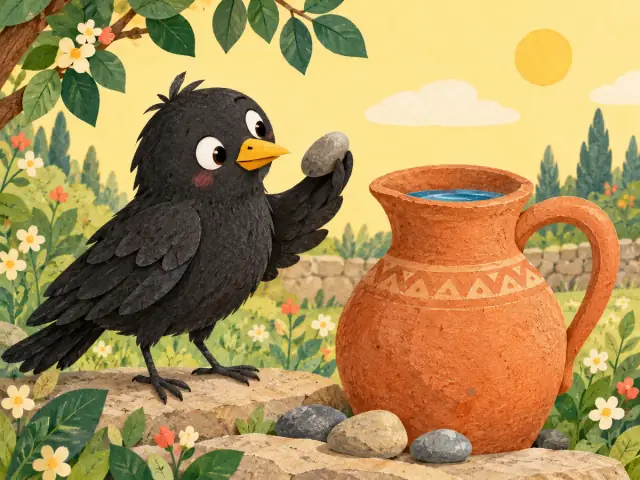
3D theatre
Enter the 3D theatre
Little discoverer, it’s your turn
Our little crow’s water experiment
- 1Predict
- 2Give it a go
- 3Tell your discovery
Keep your prediction in mind. Let’s see what happens.
How this activity works
- 01
Predict what will happen to the water level when a pebble goes in.
- 02
Add pebbles one by one in the web activity and compare the water level; remove pebbles to try again.
- 03
Describe what changed, then explain in your own words which space the pebbles took up.
Predictions and guided progress stay on this device.
A simplified equal-volume, straight-sided vessel model. The printed pitcher is a display prop.
Read aloud uses your browser’s voices. Downloaded films currently include subtitles; embedded narration is reserved for a later update.
Read this chapter · 01
A discovery in the meadow
The afternoon sun warmed the meadow. A little crow flew past an old tree and stopped in its shade. The crow was thirsty, so it looked carefully around. Beside the grass stood a pitcher with a narrow opening. Inside, a tiny patch of sky shone on the water. The crow hopped closer and leaned over the rim. There really was water at the bottom! But finding water was only the beginning. However far the crow stretched, its beak could not reach. What exactly needed to change?
Grown-up preparation
A little grown-up prep. A lot to explore.
Play on the web today. For tabletop play, prepare optional prints ahead of time. You can print this preparation and play card.
Set these on your table
- Transparent container and tray
- A little water and clean smooth pebbles
- Optional: pre-printed characters and props
Little minds lead the ideas. Grown-ups handle equipment and small props.
- 01
Prepare a suitable transparent container, a little water, a tray and clean smooth pebbles, with adult help throughout.
- 02
For a printed character, download the A1 3MF ahead of time, check the build plate and filament in Bambu Studio, then arrange printing.
- 03
The printed pitcher is a storytelling prop. Use a household transparent container for real water observations. Adults handle supports, painting and small props.
Choose what works for today
Use what you have at home
No printing wait. Observe with a cup and pebbles, then take turns as crow and narrator.
No print neededReady to start now
See the activities →Make one little crow
Print the character and use household objects for the other props.
2h 36m≈ 41.2 g · Actual slicing estimate
Choose your print files →Prepare the whole story stage
One of each file. Print extra pebbles separately if you want more.
4h 35m≈ 91.2 g · Actual slicing estimate
Choose your print files →Sum of individual estimates for the standard crow kit, including one pebble. Plate layout, filament and extra copies change time and material use. Physical prints are not yet verified.
Close the screen. Keep the story going.
Three more ways to play, off screen
Same props. A new person asking the questions. A new discovery.
- 01
Story theatre: one person is the crow, one narrates. Use the props to tell the problem, the attempts and the result, then swap roles.
- 02
Water detective: mark the water level outside a transparent container. Predict, gently add pebbles and compare different stones. Explain what makes the comparison fair.
- 03
Your turn to ask: give the crow a new problem. Invent a solution with the props you already have and tell the new version to someone in your family.
Little minds lead the ideas. Grown-ups handle equipment and small props.
Take the adventure off screen
Grown-up downloads · Standard print kit
0 props already made · 4 still to make.
Little crow
Print dimensions · 50.9 × 91.9 × 74.7 mm · Ø 40 mm
Slicer estimate · 41.2 g · 2h 36m
Sliced · physical print not yet verifiedStory pitcher
Print dimensions · 47.1 × 47.1 × 65 mm
Slicer estimate · 29.3 g · 1h 8m
Sliced · physical print not yet verifiedPebble prop
Print dimensions · 25 × 20 × 14 mm
Slicer estimate · 2.2 g · 0h 18m
Sliced · physical print not yet verifiedMeadow stage
Print dimensions · 80 × 80 × 5 mm · 80 × 80 mm
Slicer estimate · 18.5 g · 0h 35m
Sliced · physical print not yet verifiedA1 · 0.4 mm nozzle · single-colour PLA. Check your actual plate and filament in Bambu Studio. Printing and painting are adult-assisted activities.
- Take turns playing the crow and the narrator.
- Predict and compare water levels in a clear household container.
- Retell the story with two crows working together.
Want to record your own version? Open the creation tools
My version
Make it your story
Your adaptation uses the same stage. Scientific rules stay the same.
Each chapter allows up to 40 seconds. Recording stops automatically and stays private to your account.
Progress is saved on this device. Sign in to keep a private story project.
A discovery in the meadow
What makes the water difficult to reach?
Personal film export needs a desktop browser with compatible video and audio encoders. You can save and replay your project here.
Complete standard story & downloads
Complete standard story
A discovery in the meadow
The afternoon sun warmed the meadow. A little crow flew past an old tree and stopped in its shade. The crow was thirsty, so it looked carefully around. Beside the grass stood a pitcher with a narrow opening. Inside, a tiny patch of sky shone on the water. The crow hopped closer and leaned over the rim. There really was water at the bottom! But finding water was only the beginning. However far the crow stretched, its beak could not reach. What exactly needed to change?
What makes the water difficult to reach?
Trying another way
The crow tilted its head, moved around the pitcher and tried again. Stretching a little farther did not help. It gently pushed the pitcher, but the heavy vessel stayed upright. The crow paused. Repeating the same action might not bring a different result. It looked at the water, then at the narrow opening, and finally down at the ground. A few round pebbles lay among the grass. What if the crow did not need to reach farther down? Could something bring the water up instead?
What could change besides the crow's reach?
The first pebble
The crow picked up a pebble and carefully dropped it into the pitcher. Plop! The pebble sank and the surface trembled. Had the water moved? The crow looked closely. It seemed a little higher, but still too far away. Rather than deciding the idea had failed, the crow added another pebble and watched again. Each stone took up space inside the pitcher. Some of the water moved upward. Now you can try the idea. Add a pebble, pause and compare the new water level with the old one.
What happens when you add one pebble?
Water within reach
One pebble followed another. Little by little, the water rose until the crow could finally take a drink. It stopped adding stones as soon as the water was within reach. The useful idea had grown through noticing, trying and noticing again. Our scene uses equal-sized stones and a straight-sided vessel to show the change clearly. In a real pitcher, the shape of the container and the size of each stone affect how far the surface rises. Reset the scene if you want to compare the steps once more.
How many stones are enough to reach the water?
Bring the story home
The refreshed crow stands in the meadow and gives you a friendly nod. You can finish the story here, or begin again on your own table. Make the crow and its stage props, arrange the scene and tell the story in your own words. For a real observation, ask an adult to help you find a clear household container. Mark the water level before adding suitable stones. The printed pitcher is a story prop; use the clear container for the experiment. What would you like to test next?
How would you compare pebbles of different sizes?
Standard film & print files
Make a prediction, add pebbles and discover what changes.
The Crow and the Pitcher · Captioned film
· 1920 × 1080 · Ages 6–12
Video uploaded on
Read aloud uses your browser’s voices. Downloaded films currently include subtitles; embedded narration is reserved for a later update.
Your table-top story kit · The Crow and the Pitcher
A1 · 0.4 mm nozzle · single-colour PLA. Check your actual plate and filament in Bambu Studio. Printing and painting are adult-assisted activities.
Little crow
Little crow: a printable prop for The Crow and the Pitcher. Print dimensions 50.9 × 91.9 × 74.7 mm. Bambu A1 / 0.4 mm / PLA; sliced. Physical print not yet verified.
Slicer estimate: 41.2 g · 2h 36m
·
Story pitcher
Story pitcher: a printable prop for The Crow and the Pitcher. Print dimensions 47.1 × 47.1 × 65 mm. Bambu A1 / 0.4 mm / PLA; sliced. Physical print not yet verified.
Slicer estimate: 29.3 g · 1h 8m
·
Pebble prop
Pebble prop: a printable prop for The Crow and the Pitcher. Print dimensions 25 × 20 × 14 mm. Bambu A1 / 0.4 mm / PLA; sliced. Physical print not yet verified.
Slicer estimate: 2.2 g · 0h 18m
·
Meadow stage
Meadow stage: a printable prop for The Crow and the Pitcher. Print dimensions 80 × 80 × 5 mm. Bambu A1 / 0.4 mm / PLA; sliced. Physical print not yet verified.
Slicer estimate: 18.5 g · 0h 35m
·
Story notes & sources
Original retelling, narration scripts and toy-stage designs. No modern translation, textbook text, commercial character artwork or mission insignia reproduced. Source material is credited separately.
- Aesop: The Crow and the Pitcher ↗
Traditional narrative source; independently rewritten text.
A simplified equal-volume, straight-sided vessel model. The printed pitcher is a display prop.